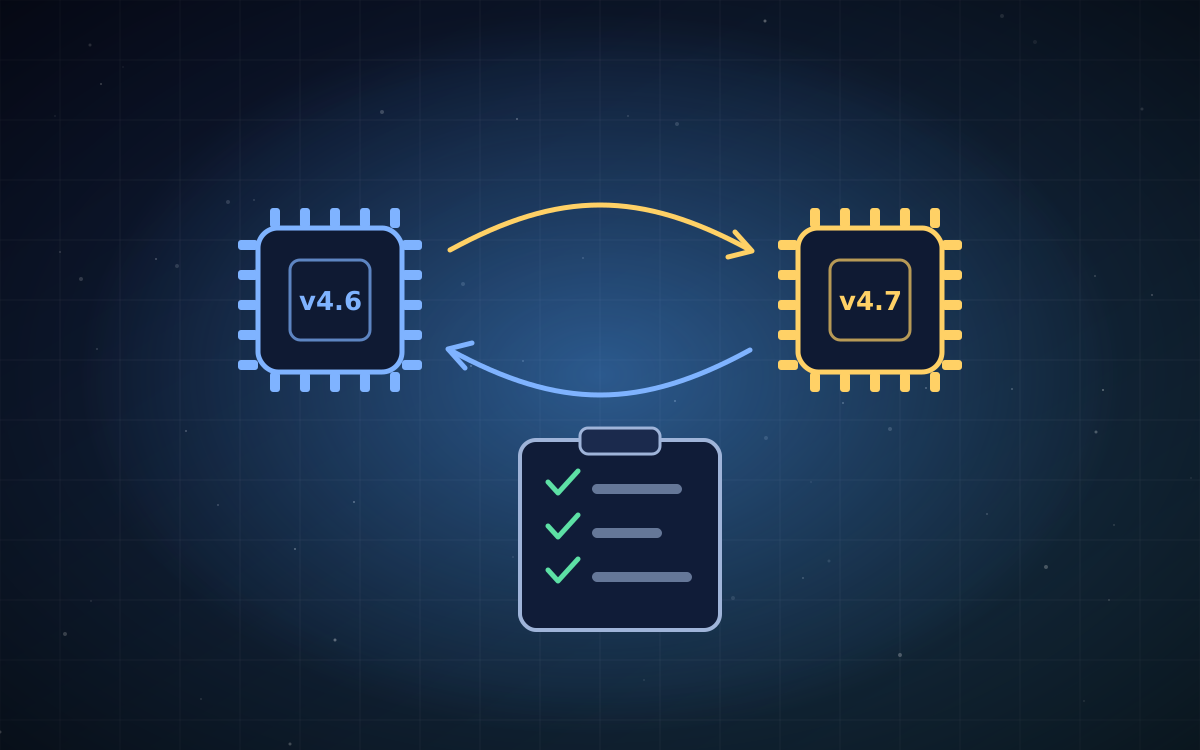
On September 21, xAI released Grok 4.7. It was available that same day in the Grok app, the xAI API, Cursor, and GitHub Copilot. Pricing matched the previous version at $2 per million input tokens and $6 per million output tokens, and xAI said the model had its "strongest safety guardrails yet."
GitHub's changelog entry for the release includes a line that compliance teams should notice: in Copilot, "new models are automatically enabled unless an administrator has turned off the global default or explicitly disables this model."
Put another way, a new model from a new provider can show up in your developers' tools without anyone at your company choosing it.
Why this is a compliance question, not only an engineering one
When teams think about switching models, they usually think about quality, speed, and cost. Your customers and auditors care about something else. A model provider is a sub-processor: another company your data passes through. Each one comes with its own data-use terms, retention policy, hosting regions, and security posture.
So when the model behind a feature changes, whether it's a new provider or just a new version with different terms, several things you've told customers may no longer be accurate:
- Your sub-processor list may be missing a provider.
- Your answers about data use (for example, "customer data is never used for training") depend on the terms of whichever model is actually in use.
- Your data residency claims depend on where the new model runs.
- Your testing evidence was produced against the old model. Its behavior on your prompts, guardrails, and edge cases is now unverified.
None of this means you shouldn't upgrade. It means an upgrade should go through a process, not just a config change.
Two places a model change can happen
1. Inside your product. Your team changes the model behind a customer-facing feature. You control this one, and it should go through change management.
2. Inside your team's tools. A coding assistant, chat tool, or internal agent starts offering a new model, sometimes enabled by default. Your source code, internal documents, and sometimes customer data can pass through these tools. This path is easy to miss because nobody on your team made a decision.
A model-change checklist
Run through this whenever the model behind a feature or tool changes:
- Identify the provider and read its terms. Who processes the data? Is it used for training? How long is it retained? Where is it hosted?
- Update your sub-processor list if the provider is new, and check whether your contracts require you to notify customers before adding one. Many enterprise agreements do.
- Re-run your AI tests against the new model: prompt injection, system prompt leakage, output filtering, and the specific edge cases your feature depends on. Guardrail behavior doesn't automatically carry over from one model version to the next.
- Refresh your documentation. Any questionnaire answer, trust page, or AI assessment that names a model or describes its behavior should reflect what's actually running.
- Record the change. Note the date, the old and new model, who approved it, and the test results. That log is your answer when an auditor asks, "How do you manage changes to your AI components?"
For internal tools: decide the default
For the second path, the fix is usually a settings change:
- Check model policies in the AI tools your team uses (Copilot, Cursor, and similar). Decide whether new models should be enabled automatically or held until someone reviews them.
- Keep an approved-models list that states which providers are allowed and for what kinds of data.
- Review it on a schedule. New models ship almost weekly, so a quarterly review is a reasonable minimum.
The bigger picture
A model release used to be something engineers read about. Now new models reach production tools within hours, sometimes turned on by default, and each one brings its own terms and behavior. Teams that treat a model change like any other change to a vendor, with review, testing, and documentation, will be able to answer customers' questions about it.
Sources